


Viktor Frankl was a psychiatrist in Vienna who was sent to the Nazi WWII concentration camps in 1942. While he was there, he lost everything, including his wife, his parents, and his brother.
When he was liberated in 1945, he went back to Vienna and wrote a book about his experiences called Man’s Search for Meaning. That book has sold over 12 million copies and remains one of the most recommended books in the world to this day.
I’ve read it, and it messed me up in the best possible way. It paints both a brutal picture of the worst of humanity and the power of hope and meaning in overcoming any situation, which can be summed up in one very famous line:
Everything can be taken from a man but one thing: the last of the human freedoms - to choose one’s attitude in any given set of circumstances, to choose one’s own way.
The theme of the book is that the deepest desire of humans is not pleasure or power but meaning. The people he met who endured the horrors of the concentration camps were the ones who found a reason to endure. And he spent the rest of his life teaching that idea to others and helping them put it into practice.
So when he was asked to sum up the meaning of his life in a single sentence, he had a good answer.
Viktor Frankl’s LifeTheme
In 2006, Man’s Search for Meaning was updated with an Afterword by philosopher, lawyer, and psychoanalyst William J. Winslade. The very last section of that Afterword recounts a story where Frankl was once asked to express in one sentence the meaning of his life. He wrote his response on a piece of paper, then asked his students to guess what he had written. After a few quiet moments, Frankl was surprised when one student guessed it exactly:
“The meaning of your life is to help others find the meaning of theirs.”
That single sentence, which defines your life’s meaning, is what I call a LifeTheme. More than just a nice-to-have, a LifeTheme gives you two critical things:
- Motivation to show up and consistently take action on what’s important
- Clarity to cut the things that are not important
You can see both of these at work in Frankl’s life.
When he left for the concentration camps, he had the manuscript for his first book (where he laid out his ideas about meaning) sewn into the lining of his jacket. It was taken from him when he arrived at Auschwitz, but instead of giving up on it, he made rebuilding it his reason to keep going. Later, when he was sick with typhus, he reconstructed as much of it as he could on strips of paper, which he claimed kept him alive on some of his worst nights.
His LifeTheme gave him something to live for, even when he lost everything else.
After the war was over, it gave him clarity. He lost his family and had every reason to return despondent like so many others. Instead, he wrote Man’s Search for Meaning in only nine days, originally published as A Psychologist Experiences the Concentration Camp in 1946. He then spent the next 50 years teaching, writing, and lecturing all over the world in an effort to help as many people as possible find meaning in their own lives.
But the part that I’m most impressed by is the fact that one of his students guessed his LifeTheme word for word. He didn’t have to announce it, because it was obvious to everyone. He lived it so clearly and consistently that someone else who observed his life could put it into words for him.
So the question I have for you today is this: Do you have a clearly articulated reason for doing what you do? And if so, is it obvious enough that the people around you can guess what it is?
Crafting Your LifeTheme
Writing a sentence that encapsulates your whole life’s meaning and purpose can feel like a monumental task. But it doesn’t have to be that difficult, and the payoff is absolutely worth the investment.
Here are 5 steps you can use to dial in your own personal LifeTheme:
- Identify your moments of impact. These are the most fulfilling moments of your life. Not necessarily the things you liked the most, but the moments where you felt most alive or like you really made an impact.
- Dream big. Most people temper their dreams to be “realistic.” But those dreams don’t provide the motivation you need to make meaningful changes. Give yourself permission to dream past what feels achievable right now.
- Create an image of your ideal future. The most powerful thing you can do is create an image, so describe your ideal future in vivid detail. The more specific it is, the more compelling it becomes.
- Identify your personal core values. Core values aren’t just for big corporations. Identifying the things that are important to you (as well as the things you refuse to do) can help you zero in on your single-sentence LifeTheme.
- Craft your LifeTheme. Take everything you’ve done and condense it down to a single sentence. It might take you some time to get it just right, so feel free to edit. The important thing is to start with something that’s exciting to you.
As an example, here’s my LifeTheme:
I help people multiply their time and talent so they can leave a bigger dent in the universe.
In short, I’m a multiplier.
You may be asking, "What does this have to do with PKM (personal knowledge management)?"
Everything.
Without getting clear on your vision and values, you end up reacting to whatever comes your way. The information you indiscriminately consume impacts the quantity and the quality of the ideas that you have, which ultimately determines the actions you take.
I call this The Default Life, and it's a pretty miserable way to live.
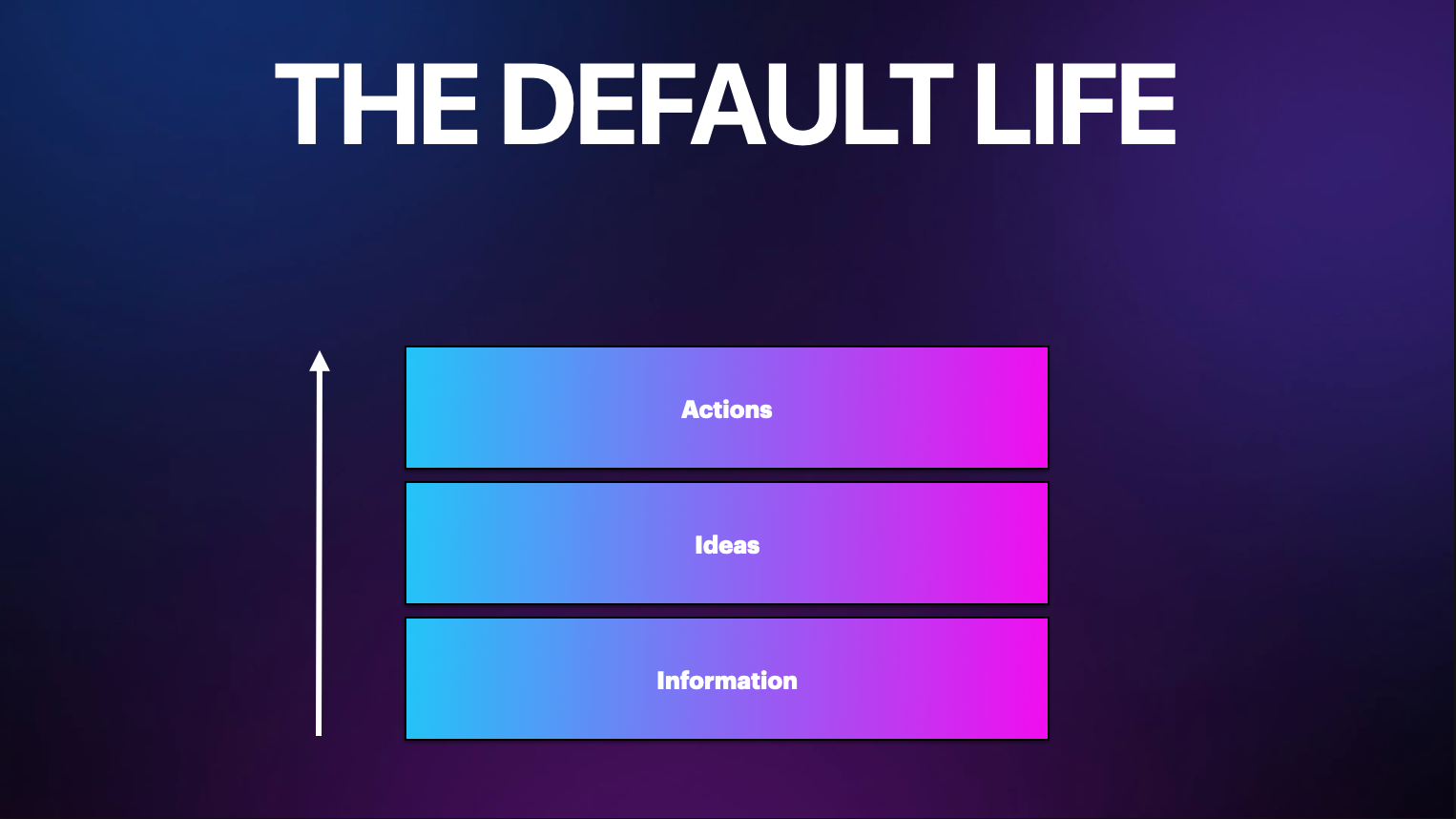
But when you start with your vision and values (your identity), you can flip the script on the default life. Your LifeTheme acts as a filter, giving you the motivation and clarity you need to focus on what matters and live a life of intention and meaning.
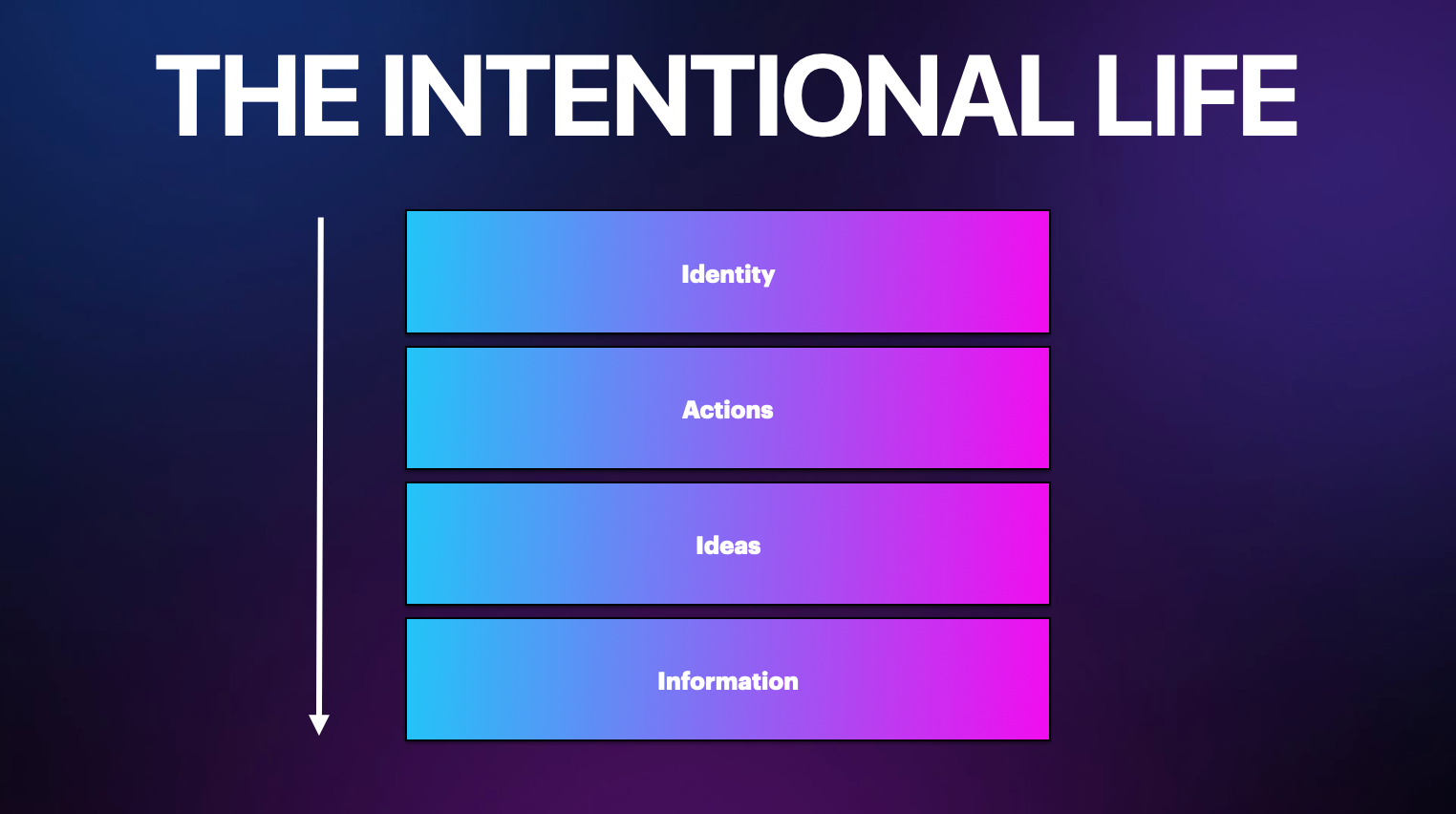
Whenever I’m presented with an opportunity, I ask myself, "Does this connect to my LifeTheme?" If it doesn’t, it’s an automatic no. I’ve learned that if something doesn’t connect to my LifeTheme, it won’t be long before I’m frustrated.
Whenever I’m presented with an opportunity, I ask myself, does this connect to my LifeTheme? If it doesn’t, it’s an automatic no. I’ve learned that if something doesn’t connect to my LifeTheme, it won’t be long before I’m frustrated.
Sometimes it won’t be obvious to me how something explicitly connects, but if I feel there’s potential for it to, I may say yes anyway. That’s where the 3 questions I ask during my Personal Retreat come in, where I force myself to pick at least one thing to say no to every time I do quarterly planning. I’m ok trying things, but it’s important to me that I stop doing things that aren’t in alignment with my vision and values. So instead of sticking with things simply because I said yes once, I ask, “Would I say yes to this if the opportunity were presented to me today?”
The Next LifeTheme Cohort Starts November 9th
While it is possible to craft your LifeTheme on your own, it’s significantly easier with a group.
That’s the reason that my wife and I started leading 6-week LifeTheme cohorts inside my private community. The next one kicks off on November 9th, and if you could use some help dialing in your own single-sentence LifeTheme, we’d love to have you join us!
You can join this cohort for $297, which includes:
- Six weeks of live sessions walking through the five-step LifeTheme process together, plus live Q&As
- Personal feedback from my wife & me on your moments of impact, core values, and LifeTheme drafts
- A private cohort space to share drafts and think out loud with people doing the same work
- The complete Craft Your LifeTheme course: 19 videos (about 4 hours), including recorded Q&As with Rachel and me
- Replays of every session and ongoing access to the course material
- Lifetime access to the Community tier of The Library
You can find more details on the sales page or click the button below to save your spot:
The Bottom Line: What’s Your Why?
Viktor Frankl didn’t survive because he had the perfect plan. He survived because he had a why.
You don’t have to be in the same horrible conditions Frankl found himself in for that to pay off. Most of us aren’t fighting for our survival — but our intentions are. Our calendars are full, our task lists are long, and we’re working hard, but it seems like we don’t make any progress.
That’s exactly the problem a LifeTheme solves. It helps you say “yes” to what really matters and “no” to the things that don’t.
If someone were to try and guess your LifeTheme based on how you spend your time, energy, and attention, what would they say? And if you aren’t sure or don’t love the answer, there’s no better time to change it than right now.


