


Last week did not go as planned.
On Monday night, I got a phone call from my sister-in-law while I was still at soccer practice.
“Don’t freak out, but…”
Ok, I wasn’t freaking out before, but now I kind of am…
“Rachel was playing with the kids in the yard, and she broke her leg.”
I was at the soccer fields 30 minutes away. But fortunately, we had family close by, and they were able to call the ambulance and make sure that all the kids (who weren’t at practice with me) were ok.
After figuring out how the soccer players would get home, I drove straight to the ER to be with my wife.
The nurse was just coming back with the X-rays when I got there. The bad news: she broke both her fibula AND tibia.
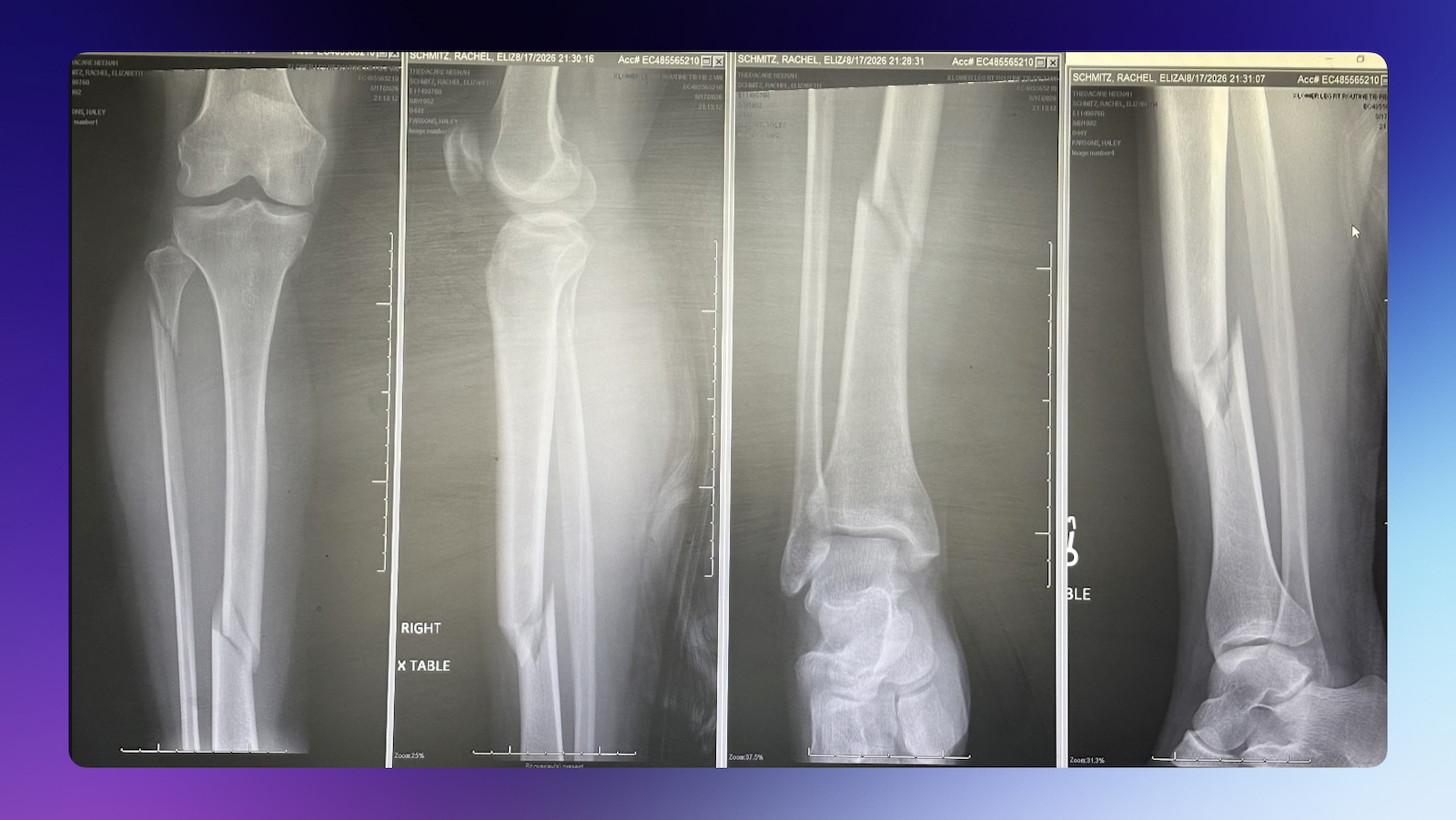
By the next morning, the surgery was done. But the real work was just beginning.
The worst possible week for it
Unfortunately, the accident happened at the worst possible time:
- I had just started coaching the varsity soccer team
- We were coordinating the big Free Market outreach at our church that Sunday
- As the director of her Classical Conversations campus, Rachel had a picnic scheduled for Thursday
- I was in the middle of a brand new cohort with 2 sessions scheduled
- We’re trying to get ready to move in less than 2 weeks
Needless to say, everything I had planned for the week got thrown out the window on Monday night when I got the phone call from my sister-in-law. In that single moment, all of the things I “had” to do last week suddenly seemed unimportant by comparison.
Not recommended, but turns out there is nothing like a crisis to help you get clear on what really matters.
It also brought to mind one of my favorite quotes by former U.S. President Dwight Eisenhower:
Plans are worthless, but planning is everything.
I’ve always liked that quote. But last week I discovered a deeper meaning than I’d ever imagined.
Take it off the shelf, throw it out the window
In 1957, Dwight Eisenhower stood in front of a room full of people whose entire job was planning for national emergencies and told them their plans were worthless.
He explained that an emergency is, by definition, the thing you didn’t plan for. If you’d planned for it, it wouldn’t be an emergency. So when one actually shows up, you don’t simply adjust the plan. You take it off the shelf, throw it out the window, and start over from where you actually are.
I didn’t think about any of that on Monday night. But even if President Eisenhower could see the future, he couldn’t have described my situation any more accurately.
The week I’d built was gone the second I picked up the phone. At first, I thought maybe I could still save some of the big things I had planned. But it wasn’t long before I realized that job #1 was being there for my wife, and everything else had to fit into whatever small pockets of time I would be able to find.
The schedule was completely blown up. The plan was indeed worthless.
But the planning I’d already done turned out to be invaluable, because I didn’t have to figure out what mattered. I already knew, which made it easier to triage.
What triage actually means
The word “triage” actually comes from the French trier, which means “to sort.” It’s a medical term from the Napoleonic wars, where Napoleon’s chief surgeon, Dominique-Jean Larrey, was dealing with more wounded men than he could possibly treat. So he did something that was genuinely radical at the time: he stopped treating soldiers according to rank and started giving them medical attention based on how badly they needed help.
He used three categories:
- Those for whom immediate medical care would make a difference in whether they lived or died
- Those who would likely survive without immediate medical care
- Those who would likely die even with immediate medical care
Two important things to understand about triage:
The first is that triage is not prioritizing. Prioritizing is putting things in ranked order, but it assumes that you’ll eventually get to all of them. Triage assumes that you won’t. One of the three possible categories gets no intervention — not because it doesn’t matter, but because your attention there doesn’t change the outcome.
The second is that Larrey’s real innovation was ignoring rank. Before him, the important people got treated first. He looked past who seemed most important and asked where his effort would actually make a difference.
That’s what I felt on Monday night. As all my commitments for the rest of the week flashed before my eyes sitting in the ER, everything quickly sorted itself into three piles:
- Non-negotiable — Being there when Rachel needed me: before surgery, when she came out, the appointments after. Whatever she needed instantly became the entire to-do list.
- Delayed — The cohort still had to happen, but it didn’t have to happen Tuesday afternoon while my wife was coming out of surgery. I messaged the attendees and pushed it a couple of days. I had to skip a couple of mastermind calls. Every other meeting got moved, and a couple of projects slipped.
- Just didn’t happen — The video scripts I was working on, the recordings I had planned. All the work that was only mine to do.
I was worried about letting people down, but everyone was incredibly gracious about it. It ended up being much less of a big deal than I had originally feared.
The Bottom Line: You can’t triage from scratch
The snippet of the Eisenhower quote I shared earlier isn’t actually the whole thing. Here’s the rest of it:
But if you haven’t been planning you can’t start to work, intelligently at least.
That’s the part that matters.
I wasn’t able to triage my responsibilities into those three piles in the ER because I’m good under pressure. I was able to do it because I’d already done the thinking. I knew what the week held, and I knew what was important. I knew which commitments had other people attached to them, and I knew which ones would quietly disappear if nobody touched them.
None of that was a plan. All of it was planning.
So make the plan, but hold it loosely. Because you never know when the phone is going to ring, and the whole thing is going to get thrown out the window.
Rachel’s surgery went well, by the way. She’s got a titanium rod in her leg now, she’s home, and she’s expected to make a full recovery.
Which means the only thing that actually mattered is the thing that got done.


