


For years, I’ve been doing something every quarter that almost nobody else I know does.
It’s not flashy. Twenty minutes of work sets the architecture for the next twelve weeks of my life. It’s quietly one of the most important planning rituals I have, and the one that makes the biggest difference in whether I actually have time for what’s most important.
I sit down with a blank weekly calendar and design my ideal week.
Triage Isn’t Planning
Imagine it’s Sunday night. You open the calendar, look at the week ahead, and start moving things around. A meeting gets rescheduled. A project deadline gets pushed. You add a couple of tasks that need to get done from your task manager. Twenty minutes later, you close the laptop and tell yourself you’ve planned the week.
But I’d argue you haven’t. You’ve merely triaged it.
The shape of your week was set the moment you started planning. You didn’t start with a blank slate. You were told what to do – by what was already on your calendar, what recently landed in your inbox, and what your task manager had queued up from last week.
You didn’t decide what your week was going to look like. You just tried to cram as much as you could into it.
As long as there’s a space, the tendency is to fill it with whatever seems most urgent.
This is why the things you say matter most tend to get crowded out. Nobody triages their way into deep work. Nobody finds the time for a regular date night. The urgent defaults are loud, and the things that actually move the needle on your career, your relationships, your health tend to speak a bit more softly.
It’s a game of volume, and the things that are truly important lose every time.
Which is why you need to design your ideal week, not plan it.
Designing a week works differently. You start with a blank grid. You decide what the shape of the week should look like — what categories of effort and rest and connection you want it to hold — before you let any specific task or meeting in. Once the shape is set, the actual stuff of life gets to live inside it.
Not the other way around.
A Practice With Some History
To be clear, I didn’t invent any of this. I just borrowed what others did before me and made it my own.
Cal Newport calls it a weekly template – a set of guidelines, set at the start of a quarter, that you reference every time you sit down to plan a specific week. I picked it up years ago and have been quietly running some version of it ever since. Through career changes, kids growing up, seasons of more work and less, more travel and less. The specific blocks I use shift every quarter, but the practice has stood the test of time. That’s what convinced me it was worth building a tool around – most planning advice doesn’t survive a real life with real chaos in it. This one does.
But before we get to how I do it, we need to talk about the part most people get wrong.
Give Every Hour a Mode, Not a Job
The mistake almost everyone makes when they try this is going too granular.
They sit down with a blank weekly calendar, their list of obligations, and start filling in the boxes:
- 8:00 - Check email
- 9:00 - Q3 deck
- 10:00 - Review marketing draft
- 1:00 - Call with Sarah
By Wednesday, none of it has happened the way they thought it would. The call was moved. The Q3 deck took twice as long as expected. Email ate the entire morning. The whole plan starts to feel like a lie, and by Friday, they’ve quietly abandoned it.
The fix isn’t more discipline. It’s to create a template that helps you naturally protect the time for the things that matter.
The process is pretty simple:
- Figure out what’s important to you
- Block time for it on your weekly calendar template
- Try to stick to that template when you're time-blocking your day
But when you’re creating your weekly template, you need to approach things a little differently:
Unlike time-blocking, don’t give every hour a task. Give every hour a mode.
Deep work. Exercise. Family time. Date night. Soccer practice. 1-on-1s. The specifics can change week to week, but the modes stay the same. That’s what you’re protecting.
This may sound like a small distinction. It isn’t.
A weekly plan made of random tasks shatters the first time the week goes sideways because there’s no big picture to compare it against – and weekly plans always go sideways.
Plans are worthless, but planning is everything. - Dwight Eisenhower
It’s impossible to plan your entire week with specific tasks and have it survive completely intact.
But a week template made of modes is less a schedule and more a picture of what your life looks like when you’re at your best.
When you fill in those blocks – here’s where deep work lives, here’s where I’m fully present with my kids, here’s when I read, here’s when I move my body – you’re describing the version of yourself you’re trying to become. The template isn’t a cage you’re trying to fit a real week into. It’s a model of what a good week looks like for you, in this season of life.
It’s a reflection of your vision and values. A reference picture you can use to evaluate the week you’re actually living.
Here's what my ideal week template looks like:
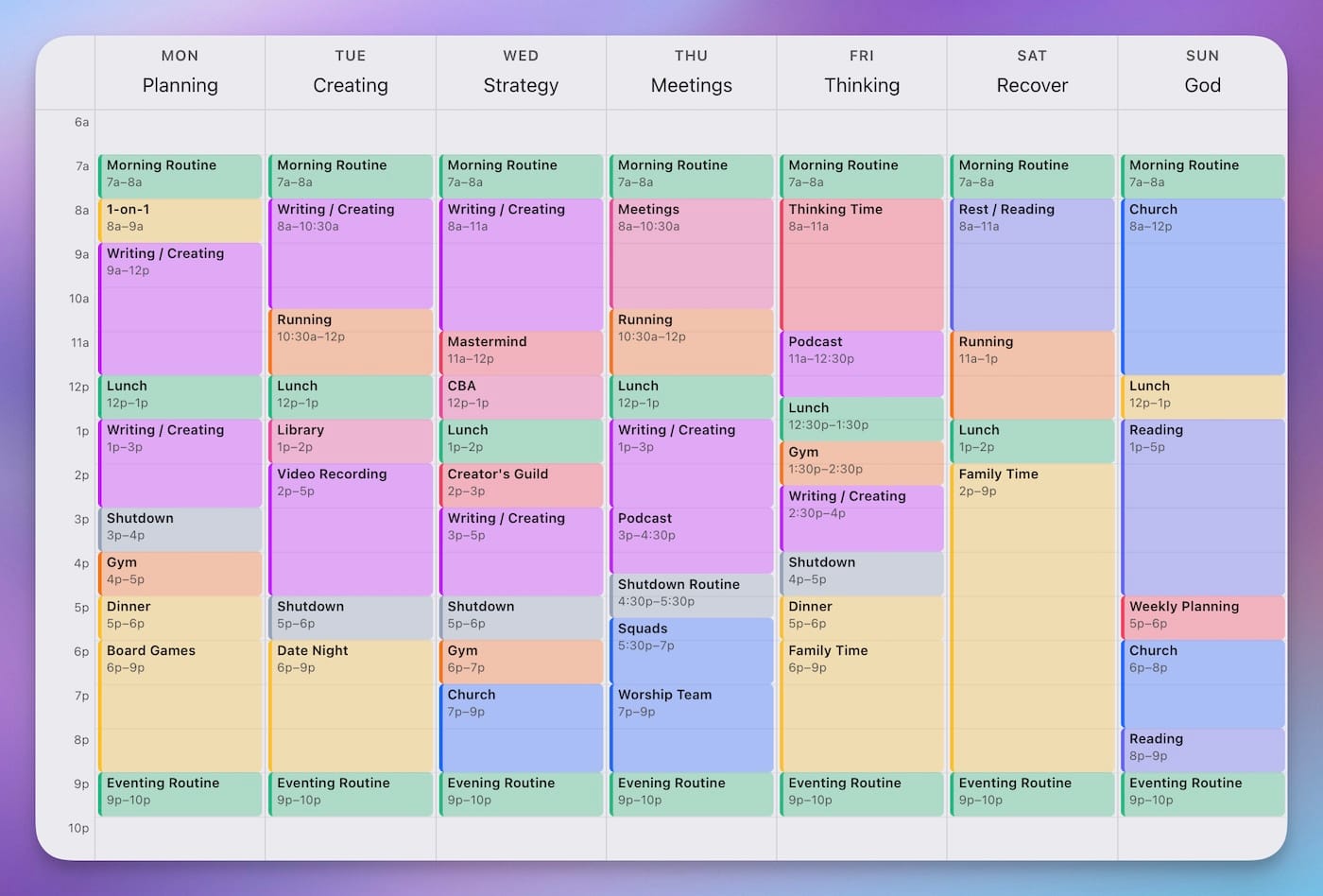
I'd walk you through the specifics, but honestly, it's not important. The takeaway here is that I've created a template for what my ideal week looks like.
Some weeks, I do a pretty good job sticking to this. Other weeks, it's not even close. That’s not the point. The point is having something to aim at – a tangible image of what “a good week” looks like in this specific season of your life.
Without the ideal week template, every plan is just a gut reaction to whatever is screaming at you the loudest. With it, you have a direction. You know what you’re trying to build toward, hour by hour. And you can tell, by Friday, whether you spent the week building that life or some other one.
Once a Quarter Is Enough
I revisit my ideal week every quarter, as part of a personal retreat I take to step back and look at the bigger picture of my life and work.
That cadence isn’t arbitrary. A weekly template you tune every Sunday becomes another thing on the to-do list. But the whole point is to take a decision off the list, not add another moving part. Quarterly is the right rhythm because life actually changes at that pace. A new season, a new school year, a new project, a kid who switched sports. Quarterly catches those shifts without inviting weekly tinkering.
In between retreats, the template lives in my digital planner where I can pull it up alongside the week I’m actually about to live. When I sit down for my weekly planning session, I’m not trying to recreate the template exactly – that’s never going to happen. I’m using it as a reference, scanning the upcoming week, and asking: Do I have space set aside for the things that I said matter?
There will be gaps. A meeting lands where deep work was supposed to live. A kid’s event takes a Saturday morning I’d marked for reading. The template doesn’t tell me to move those – it tells me where I need to fight harder to protect the space that’s left. If deep work got eaten on Tuesday, I’m looking for where it can live instead. If family time got compressed, I’m finding the next place to expand it.
But I don’t change the template itself.
I Built You a Tool For This
I’ve been recommending this practice for a long time as part of my Personal Retreat process (I have a video that walks through the whole thing here). You can do it with any calendar app, a notebook, or a spreadsheet. None of it is technically hard.
But almost nobody does. The blank page is intimidating, the setup feels like a project, and the moment passes.
So I built a tool to make starting easier.
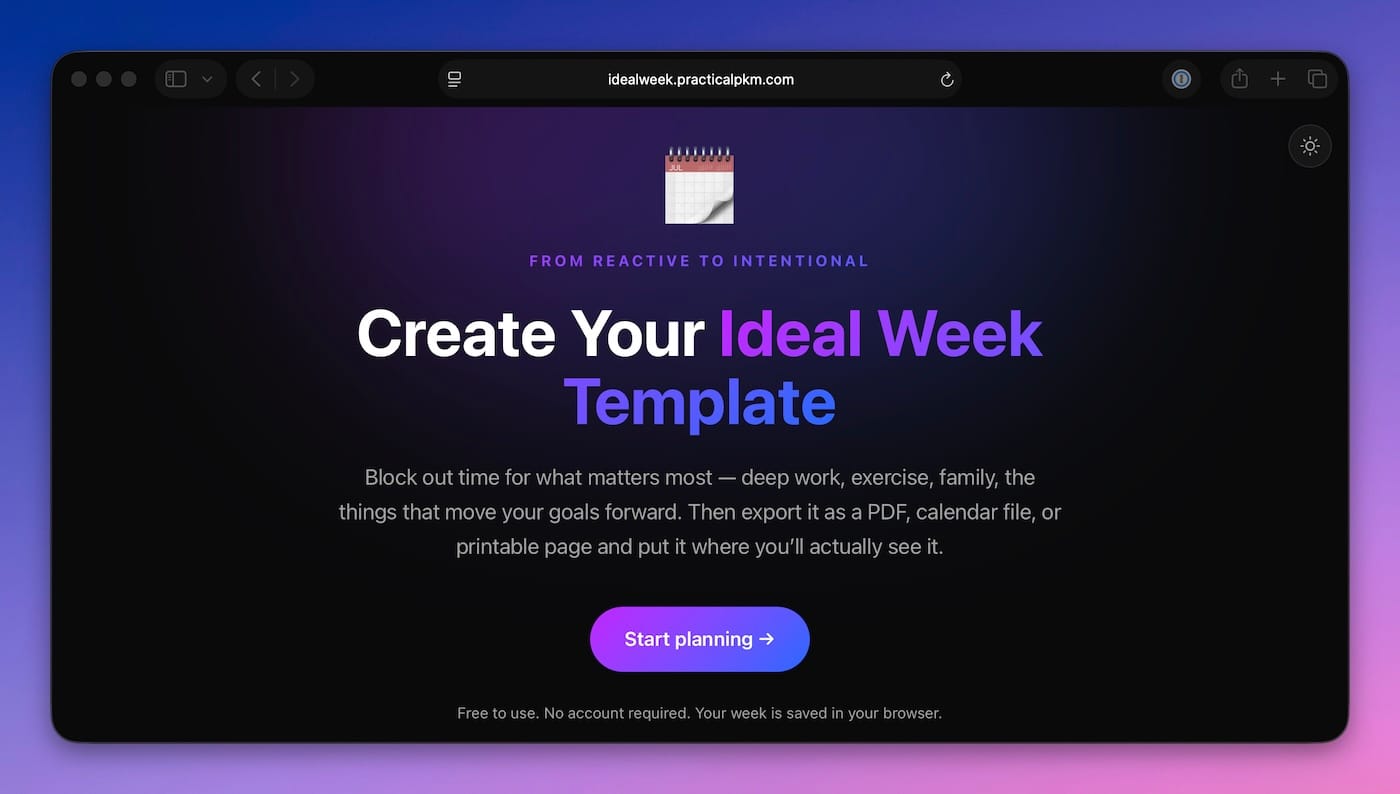
It lives at idealweek.practicalpkm.com. Drag across the grid to create a block. Click a block to label it and color-code it. Then just give every hour a mode as you create your ideal week template. The whole point is to get a clean visual of what you want your week to look like – fast, no friction, no setup.
When you’re done, you can export it in several different ways:
- PDF for a clean version you can save or send
- PNG to drop into Notion, a sticky note, or anywhere else
- Printable page if you want to tape it to the wall above your desk
- Markdown for those who live in Obsidian
- .ics file to import the recurring blocks straight into your calendar
It’s completely free to use. Your week is saved in your browser, so you can come back and revise it later.
The Bottom Line: Design Your Ideal Week
You don’t have to plan a perfect week. The truth is, you couldn’t if you tried. No real week is going to match the template exactly, and that’s not what the template is for.
The weekly template is a portrait of the life you’re trying to build, hour by hour. The week you design is the person you’re becoming. The week you triage is the person you’re settling for.
So spend twenty minutes this week. Open the tool. Sketch the shape of the week you actually want to live using modes, not tasks. Then put it somewhere you’ll see it.
Because if you don’t decide what your hours are for, I guarantee you that somebody else will.


