


Video Review
3 Sentence Summary
- Lasting happiness comes from embracing change and finding new ways to grow as you move through different stages of life.
- Letting go of past achievements and focusing on developing new strengths leads to deeper fulfillment and purpose.
- Prioritizing relationships, wisdom, and inner growth helps you create a more meaningful and satisfying second half of life.
Mind Map
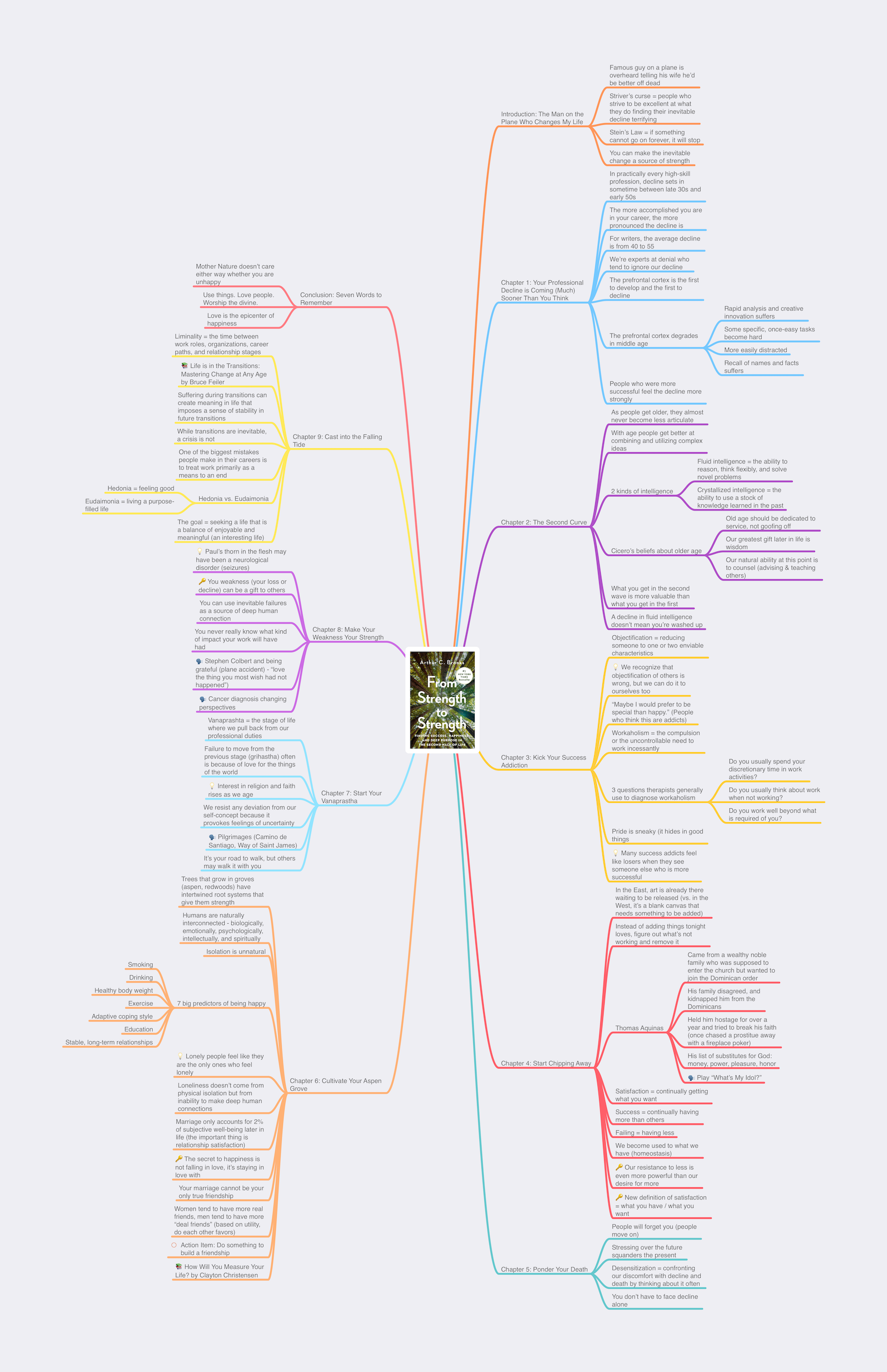
Introduction: The Man on the Plane Who Changed My Life
- A famous guy on a plane is overheard telling his wife he’d be better off dead
- Striver’s curse = people who strive to be excellent at what they do, finding their inevitable decline terrifying
- Stein’s Law = if something cannot go on forever, it will stop
- You can make the inevitable change a source of strength
Chapter 1: Your Professional Decline is Coming (Much) Sooner Than You Think
- In practically every high-skill profession, decline sets in sometime between late 30s and early 50s
- The more accomplished you are in your career, the more pronounced the decline is
- For writers, the average decline is from 40 to 55
- We’re experts at denial who tend to ignore our decline
- The prefrontal cortex is the first to develop and the first to decline
- The prefrontal cortex degrades in middle age
- Rapid analysis and creative innovation suffers
- Some specific, once-easy tasks become hard
- More easily distracted
- Recall of names and facts suffers
- People who were more successful feel the decline more strongly
Chapter 2: The Second Curve
- As people get older, they almost never become less articulate
- With age, people get better at combining and utilizing complex ideas
- 2 kinds of intelligence
- Fluid intelligence = the ability to reason, think flexibly, and solve novel problems
- Crystallized intelligence = the ability to use a stock of knowledge learned in the past
- Cicero’s beliefs about older age
- Old age should be dedicated to service, not goofing off
- Our greatest gift later in life is wisdom
- Our natural ability at this point is to counsel (advising & teaching others)
- What you get in the second wave is more valuable than what you get in the first
- A decline in fluid intelligence doesn’t mean you’re washed up
Chapter 3: Kick Your Success Addiction
- Objectification = reducing someone to one or two enviable characteristics
- 💡 We recognize that objectification of others is wrong, but we can do it to ourselves, too
- “Maybe I would prefer to be special than happy.” (People who think this are addicts)
- Workaholism = the compulsion or the uncontrollable need to work incessantly
- 3 questions therapists generally use to diagnose workaholism
- Do you usually spend your discretionary time in work activities?
- Do you usually think about work when not working?
- Do you work well beyond what is required of you?
- Pride is sneaky (it hides in good things
- 💡 Many success addicts feel like losers when they see someone else who is more successful
Chapter 4: Start Chipping Away
- In the East, art is already there waiting to be released (vs. in the West, it’s a blank canvas that needs something to be added)
- Instead of adding things tonight loves, figure out what’s not working and remove it
- Thomas Aquinas
- Came from a wealthy noble family, who was supposed to enter the church but wanted to join the Dominican order
- His family disagreed, and kidnapped him from the Dominicans
- Held him hostage for over a year and tried to break his faith (once chased a prostitute away with a fireplace poker)
- His list of substitutes for God: money, power, pleasure, honor
- 🗣️ Play “What’s My Idol?”
- Satisfaction = continually getting what you want
- Success = continually having more than others
- Failing = having less
- We become used to what we have (homeostasis)
- 🔑 Our resistance to less is even more powerful than our desire for more
- 🔑 New definition of satisfaction = what you have / what you want
Chapter 5: Ponder Your Death
- People will forget you (people move on)
- Stressing over the future squanders the present
- Desensitization = confronting our discomfort with decline and death by thinking about it often
- You don’t have to face decline alone
Chapter 6: Cultivate Your Aspen Grove
- Trees that grow in groves (aspen, redwoods) have intertwined root systems that give them strength
- Humans are naturally interconnected - biologically, emotionally, psychologically, intellectually, and spiritually
- Isolation is unnatural
- 7 big predictors of being happy
- Smoking
- Drinking
- Healthy body weight
- Exercise
- Adaptive coping style
- Education
- Stable, long-term relationships
- 💡 Lonely people feel like they are the only ones who feel lonely
- Loneliness doesn’t come from physical isolation but from inability to make deep human connections
- Marriage only accounts for 2% of subjective well-being later in life (the important thing is relationship satisfaction)
- 🔑 The secret to happiness is not falling in love, it’s staying in love with
- Your marriage cannot be your only true friendship
- Women tend to have more real friends, men tend to have more “deal friends” (based on utility, do each other favors)
- Action Item: Do something to build a friendship
- 📚 How Will You Measure Your Life? by Clayton Christensen
Chapter 7: Start Your Vanaprastha
- Vanaprashta = the stage of life where we pull back from our professional duties
- Failure to move from the previous stage (grihastha) often is because of love for the things of the world
- 💡 Interest in religion and faith rises as we age
- We resist any deviation from our self-concept because it provokes feelings of uncertainty
- 🗣️ Pilgrimages (Camino de Santiago, Way of Saint James)
- It’s your road to walk, but others may walk it with you
Chapter 8: Make Your Weakness Your Strength
- 💡 Paul’s thorn in the flesh may have been a neurological disorder (seizures)
- 🔑 Your weakness (your loss or decline) can be a gift to others
- You can use inevitable failures as a source of deep human connection
- You never really know what kind of impact your work will have had
- 🗣️ Stephen Colbert and being grateful (plane accident) - “love the thing you most wish had not happened”)
- 🗣️ Cancer diagnosis changing perspectives
Chapter 9: Cast into the Falling Tide
- Liminality = the time between work roles, organizations, career paths, and relationship stages
- 📚 Life is in the Transitions: Mastering Change at Any Age by Bruce Feiler
- Suffering during transitions can create meaning in life that imposes a sense of stability in future transitions
- While transitions are inevitable, a crisis is not
- One of the biggest mistakes people make in their careers is to treat work primarily as a means to an end
- Hedonia vs. Eudaimonia
- Hedonia = feeling good
- Eudaimonia = living a purpose-filled life
- The goal = seeking a life that is a balance of enjoyable and meaningful (an interesting life)
Conclusion: Seven Words to Remember
- Mother Nature doesn’t care either way whether you are unhappy
- Use things. Love people. Worship the divine.
- Love is the epicenter of happiness


