


3 Sentence Summary
- Goals aren't enough to get you where you want to go (you must have systems in place that can get you there).
- Very small changes in your daily action (habits) aligned with the identity of the person you want to become compound to significant results over time.
- There are 4 steps to the habit cycle (not 3) that you can leverage to make it easier to take the desired action (or avid the undesired action) consistently.
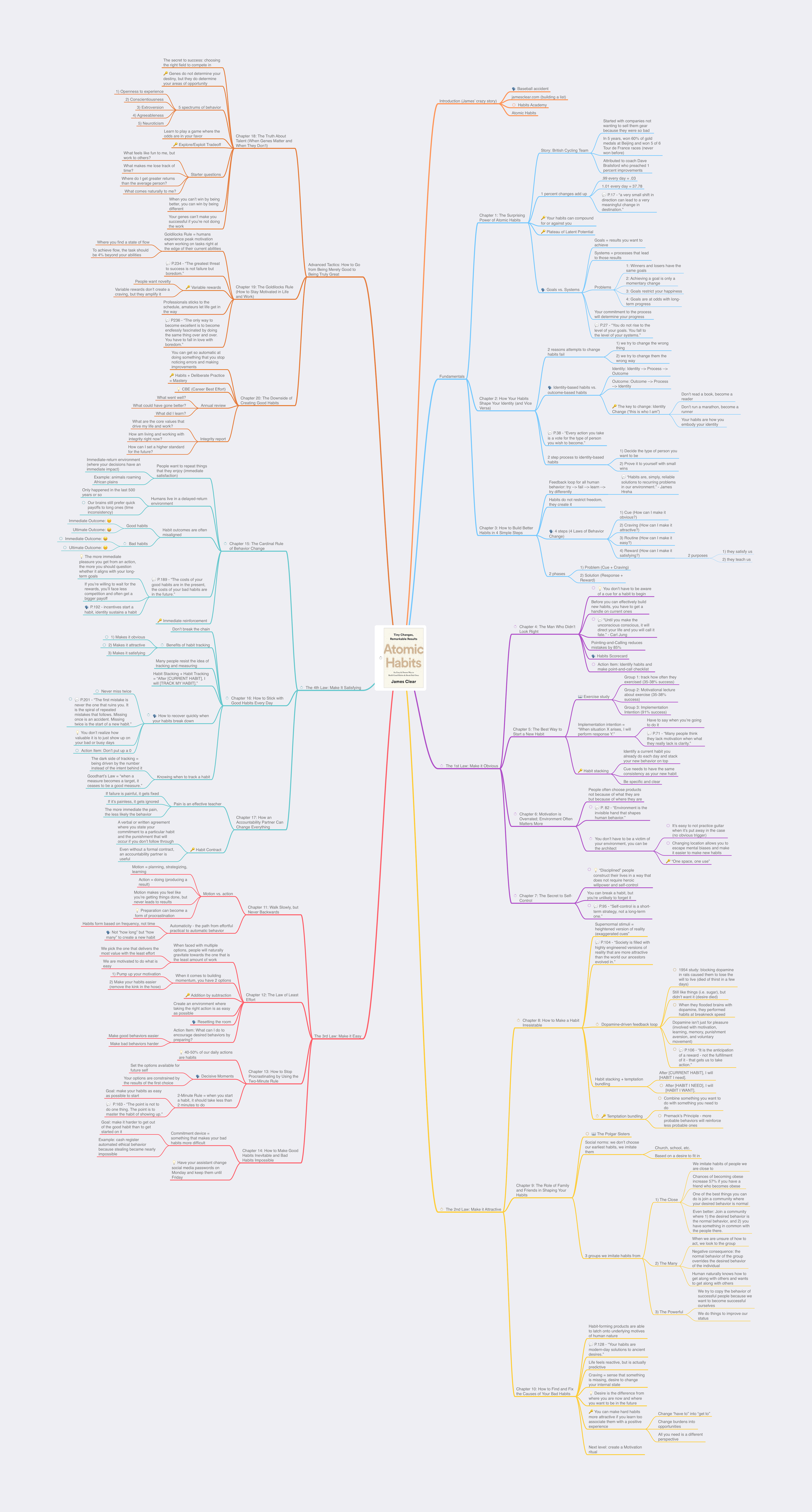
Introduction (James’ crazy story)
- 🗣 Baseball accident
- jamesclear.com (building a list)
- Habits Academy
- Atomic Habits
Fundamentals
Chapter 1: The Surprising Power of Atomic Habits
- Story: British Cycling Team
- Started with companies not wanting to sell them gear because they were so bad
- In 5 years, won 60% of gold medals at Beijing and won 5 of 6 Tour de France races (never won before)
- Attributed to coach Dave Brailsford who preached 1 percent improvements
- 1 percent changes add up
- .99 every day = .03
- 1.01 every day = 37.78
- 💬 P.17 - “a very small shift in direction can lead to a very meaningful change in destination.”
- 🔑 Your habits can compound for or against you
- 🔑 Plateau of Latent Potential
- 🗣 Goals vs. Systems
- Goals = results you want to achieve
- Systems = processes that lead to those results
- Problems
- Winners and losers have the same goals
- Achieving a goal is only a momentary change
- Goals restrict your happiness
- Goals are at odds with long-term progress
- Your commitment to the process will determine your progress
- 💬 P.27 - “You do not rise to the level of your goals. You fall to the level of your systems.”
Chapter 2: How Your Habits Shape Your Identity (and Vice Versa)
- 2 reasons attempts to change habits fail
- We try to change the wrong thing
- We try to change them the wrong way
- 🗣 Identity-based habits vs. outcome-based habits
- Identity: Identity --> Process --> Outcome
- Outcome: Outcome --> Process --> Identity
- 🔑 The key to change: Identity Change (“this is who I am”)
- Don’t read a book, become a reader
- Don’t run a marathon, become a runner
- Your habits are how you embody your identity
- 💬 P.38 - “Every action you take is a vote for the type of person you wish to become.”
- 2-step process to identity-based habits
- Decide the type of person you want to be
- Prove it to yourself with small wins
Chapter 3: How to Build Better Habits in 4 Simple Steps
- Feedback loop for all human behavior: try --> fail --> learn --> try differently
- 💬 “Habits are, simply, reliable solutions to recurring problems in our environment.” James Hrera
- Habits do not restrict freedom, they create it
- 🗣 4 steps (4 Laws of Behavior Change)
- Cue (How can I make it obvious?)
- Craving (How can I make it attractive?)
- Routine (How can I make it easy?)
- Reward (How can I make it satisfying?)
- 2 purposes
- They satisfy us
- They teach us
- 2 purposes
- 2 phases
- Problem (Cue + Craving)
- Solution (Response + Reward)
The 1st Law: Make it Obvious
Chapter 4: The Man Who Didn’t Look Right
- 💡 You don’t have to be aware of a cue for a habit to begin
- Before you can effectively build new habits, you have to get a handle on current ones
- 💬 “Until you make the unconscious conscious, it will direct your life and you will call it fate.” Carl Jung
- Pointing-and-Calling reduces mistakes by 85%
- 🗣️ Habits Scorecard
- Action Item: Identify habits and make point-and-call checklist
Chapter 5: The Best Way to Start a New Habit
- 📖 Exercise study
- Group 1: track how often they exercised (35-38% success)
- Group 2: Motivational lecture about exercise (35-38% success)
- Group 3: Implementation Intention (91% success)
- Implementation intention = “When situation X arises, I will perform response Y.”
- Have to say when you’re going to do it
- 💬 P.71 - “Many people think they lack motivation when what they really lack is clarity.”
- 🔑 Habit stacking
- Identify a current habit you already do each day and stack your new behavior on top
- Cue needs to have the same consistency as your new habit
- Be specific and clear
Chapter 6: Motivation is Overrated; Environment Often Matters More
- People often choose products not because of what they are but because of where they are
- 💬 P. 82 - “Environment is the invisible hand that shapes human behavior.”
- You don’t have to be a victim of your environment, you can be the architect
- It’s easy to not practice guitar when it’s put away in the case (no obvious trigger)
- Changing location allows you to escape mental biases and make it easier to make new habits
- 🔑 “One space, one use”
Chapter 7: The Secret to Self-Control
- 💡 “Disciplined” people construct their lives in a way that does not require heroic willpower and self-control
- You can break a habit, but you’re unlikely to forget it
- 💬 P.95 - “Self-control is a short-term strategy, not a long-term one.”
The 2nd Law: Make it Attractive
Chapter 8: How to Make a Habit Irresistable
- Supernormal stimuli = heightened version of reality (exaggerated cues”
- 💬 P.104 - “Society is filled with highly engineered versions of reality that are more attractive than the world our ancestors evolved in.”
- Dopamine-driven feedback loop
- 1954 study: blocking dopamine in rats caused them to lose the will to live (died of thirst in a few days)
- Still like things (i.e. sugar), but didn’t want it (desire died)
- When they flooded brains with dopamine, they performed habits at breakneck speed
- Dopamine isn’t just for pleasure (involved with motivation, learning, memory, punishment aversion, and voluntary movement)
- 💬 P.106 - “It is the anticipation of a reward - not the fulfillment of it - that gets us to take action.”
- Habit stacking + temptation bundling
- After [CURRENT HABIT], I will [HABIT I need].
- After [HABIT I NEED], I will [HABIT I WANT].
- 🔑 Temptation bundling
- Combine something you want to do with something you need to do
- Premack’s Principle - more probable behaviors will reinforce less probable ones
Chapter 9: The Role of Family and Friends in Shaping Your Habits
- 📖 The Polgar Sisters
- Social norms: we don’t choose our earliest habits, we imitate them
- Church, school, etc.
- Based on a desire to fit in
- 3 groups we imitate habits from
- The Close
- We imitate habits of people we are close to
- Chances of becoming obese increase 57% if you have a friend who becomes obese
- One of the best things you can do is join a community where your desired behavior is normal
- Even better: Join a community where 1) the desired behavior is the normal behavior, and 2) you have something in common with the people there.
- The Close
- The Many
- When we are unsure of how to act, we look to the group
- Negative consequence: the normal behavior of the group overrides the desired behavior of the individual
- Human naturally knows how to get along with others and wants to get along with others
- The Powerful
- We try to copy the behavior of successful people because we want to become successful ourselves
- We do things to improve our status
Chapter 10: How to Find and Fix the Causes of Your Bad Habits
- Habit-forming products are able to latch onto underlying motives of human nature
- 💬 P.128 - “Your habits are modern-day solutions to ancient desires.”
- Life feels reactive, but is actually predictive
- Craving = sense that something is missing, desire to change your internal state
- 💡 Desire is the difference from where you are now and where you want to be in the future
- 🔑 You can make hard habits more attractive if you learn too associate them with a positive experience
- Change “have to” into “get to”
- Change burdens into opportunities
- All you need is a different perspective
- Next level: create a Motivation ritual
The 3rd Law: Make it Easy
Chapter 11: Walk Slowly, but Never Backwards
- Motion vs. action
- Motion = planning, strategizing, learning
- Action = doing (producing a result)
- Motion makes you feel like you’re getting things done, but never leads to results
- 💡 Preparation can become a form of procrastination
- Automaticity - the path from effortful practical to automatic behavior
- Habits form based on frequency, not time
- 🗣 Not “how long” but “how many” to create a new habit
Chapter 12: The Law of Least Effort
- When faced with multiple options, people will naturally gravitate towards the one that is the least amount of work
- We pick the one that delivers the most value with the least effort
- We are motivated to do what is easy
- When it comes to building momentum, you have 2 options
- Pump up your motivation
- Make your habits easier (remove the kink in the hose)
- 🔑 Addition by subtraction
- Create an environment where taking the right action is as easy as possible
- 🗣 Resetting the room
- Action Item: What can I do to encourage desired behaviors by preparing?
- Make good behaviors easier
- Make bad behaviors harder
Chapter 13: How to Stop Procrastinating by Using the Two-Minute Rule
- 💡 40-50% of our daily actions are habits
- 🗣 Decisive Moments
- Set the options available for future self
- Your options are constrained by the results of the first choice
- 2-Minute Rule = when you start a habit, it should take less than 2 minutes to do
- Goal: make your habits as easy as possible to start
- 💬 P.163 - “The point is not to do one thing. The point is to master the habit of showing up.”
Chapter 14: How to Make Good Habits Inevitable and Bad Habits Impossible
- Commitment device = something that makes your bad habits more difficult
- Goal: make it harder to get out of the good habit than to get started on it
- Example: cash register automated ethical behavior because stealing became nearly impossible
- 💡 Have your assistant change social media passwords on Monday and keep them until Friday
The 4th Law: Make It Satisfying
Chapter 15: The Cardinal Rule of Behavior Change
- People want to repeat things that they enjoy (immediate satisfaction)
- Immediate-return environment (where your decisions have an immediate impact)
- Example: animals roaming African plains
- Humans live in a delayed-return environment
- Only happened in the last 500 years or so
- Our brains still prefer quick payoffs to long ones (time inconsistency)
- Habit outcomes are often misaligned
- Good habits
- Immediate Outcome: ☹️
- Ultimate Outcome: 😀
- Bad habits
- Immediate Outcome: 😀
- Ultimate Outcome: ☹️
- Good habits
- 💬 P.189 - “The costs of your good habits are in the present, the costs of your bad habits are in the future.”
- 💡 The more immediate pleasure you get from an action, the more you should question whether it aligns with your long-term goals
- If you’re willing to wait for the rewards, you’ll face less competition and often get a bigger payoff
- 🗣 P.192 - incentives start a habit, identity sustains a habit
- 🔑 Immediate reinforcement
Chapter 16: How to Stick with Good Habits Every Day
- Don’t break the chain
- Benefits of habit tracking
- Makes it obvious
- Makes it attractive
- Makes it satisfying
- Many people resist the idea of tracking and measuring
- Habit Stacking + Habit Tracking = “After [CURRENT HABIT], I will [TRACK MY HABIT].”
- 🗣️ How to recover quickly when your habits break down
- Never miss twice
- 💬 P.201 - “The first mistake is never the one that ruins you. It is the spiral of repeated mistakes that follows. Missing once is an accident. Missing twice is the start of a new habit.”
- 💡 You don’t realize how valuable it is to just show up on your bad or busy days
- Action Item: Don’t put up a 0
- Knowing when to track a habit
- The dark side of tracking = being driven by the number instead of the intent behind it
- Goodhart’s Law = “when a measure becomes a target, it ceases to be a good measure.”
Chapter 17: How an Accountability Partner Can Change Everything
- Pain is an effective teacher
- If failure is painful, it gets fixed
- If it’s painless, it gets ignored
- The more immediate the pain, the less likely the behavior
- 🔑 Habit Contract
- A verbal or written agreement where you state your commitment to a particular habit and the punishment that will occur if you don’t follow through
- Even without a formal contract, an accountability partner is useful
Advanced Tactics: How to Go from Being Merely Good to Being Truly Great
Chapter 18: The Truth About Talent (When Genes Matter and When They Don’t)
- The secret to success: choosing the right field to compete in
- 🔑 Genes do not determine your destiny, but they do determine your areas of opportunity
- 5 spectrums of behavior
- Openness to experience
- Conscientiousness
- Extroversion
- Agreeableness
- Neuroticism
- Learn to play a game where the odds are in your favor
- 🔑 Explore/Exploit Tradeoff
- Starter questions
- What feels like fun to me, but work to others?
- What makes me lose track of time?
- Where do I get greater returns than the average person?
- What comes naturally to me?
- When you can’t win by being better, you can win by being different
- Your genes can’t make you successful if you’re not doing the work
Chapter 19: The Goldilocks Rule (How to Stay Motivated in Life and Work)
- Goldilocks Rule = humans experience peak motivation when working on tasks right at the edge of their current abilities
- Where you find a state of flow
- To achieve flow, the task should be 4% beyond your abilities
- 💬 P.234 - “The greatest threat to success is not failure but boredom.”
- 🔑 Variable rewards
- People want novelty
- Variable rewards don’t create a craving, but they amplify it
- Professionals stick to the schedule, amateurs let life get in the way
- 💬 P.236 - “The only way to become excellent is to become endlessly fascinated by doing the same thing over and over. You have to fall in love with boredom.”
Chapter 20: The Downside of Creating Good Habits
- You can get so automatic at doing something that you stop noticing errors and making improvements
- 🔑 Habits + Deliberate Practice = Mastery
- 💡 CBE (Career Best Effort)
- Annual review
- What went well?
- What could have gone better?
- What did I learn?
- Integrity report
- What are the core values that drive my life and work?
- How am I living and working with integrity right now?
- How can I set a higher standard for the future?


